
blue button
Every marketer knows Seth Godin's “Purple Cow”: the remarkable lives in the product, not in the ad. A purple cow doesn't try to please everyone (a purple cow that pleases everyone is a brown cow); it splits the market. It's impossible to ignore.
eesier is your autonomous SDR. But what is our purple cow? What is the contrarian thesis we carry into the market?
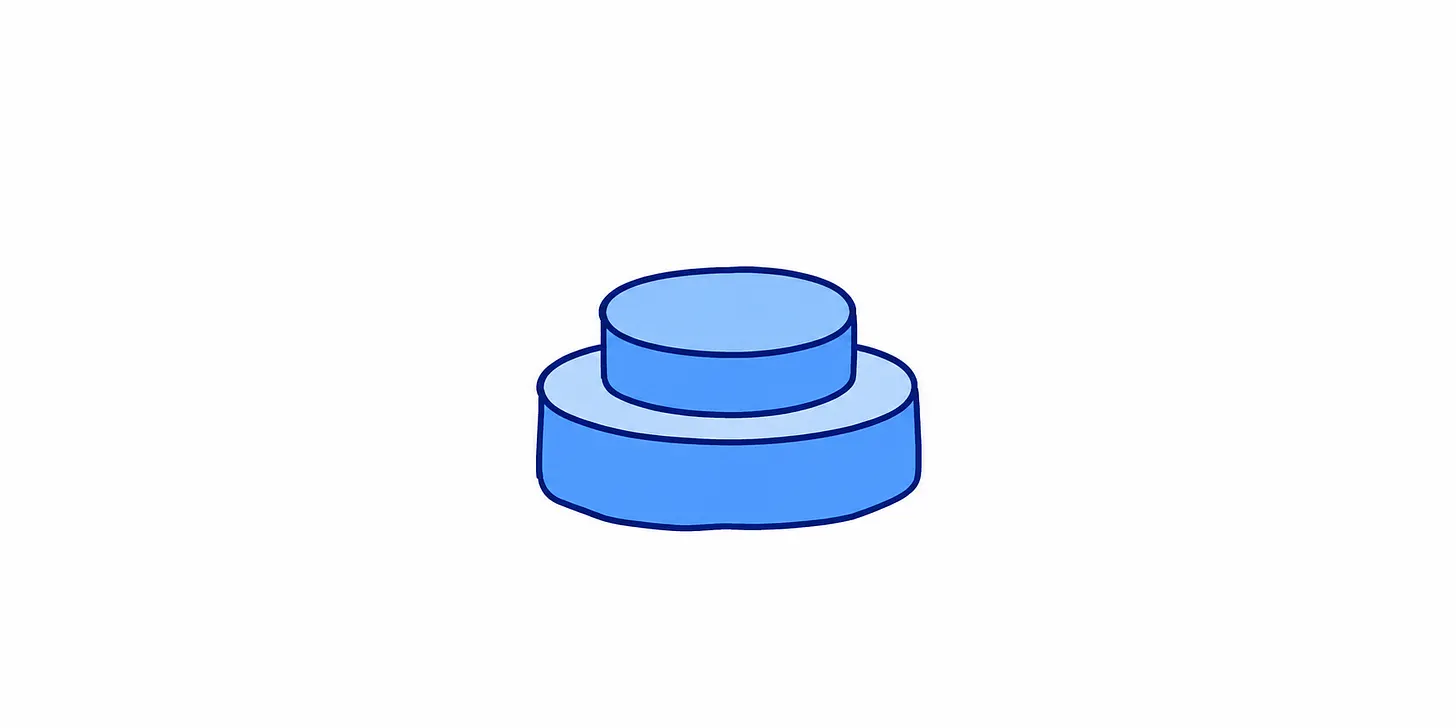
To understand it, we need to look at the symbol of our product: the blue button.
The central inversion of our narrative is the battle of Dashboard vs. Button. The entire sales-tech world sells the same thing: more complexity. More tools, more seats, more SDRs to hire and ramp, more dashboards, more 47-step sequences. They sell you a cockpit with a thousand levers. The implicit promise of the whole category is: “we give you a more sophisticated machine for you to operate.”
eesier sells the exact opposite. We don't deliver a better machine for you to operate — we deliver the end of the operation.
Every competitor builds a dashboard. We build a button. That's our purple cow: the categorical refusal to sell complexity in a market that only knows how to sell complexity.
The Psychology of BlueFrom “go to work” to “it's already done”
The blue button isn't an aesthetic detail; it's the core of the narrative.
Think about it: blue is the color of action across the entire internet. It's the color of the link, of “Connect” on LinkedIn, of “Send”. It's the button humanity has clicked a billion times to do the work itself. Every piece of B2B prospecting that ever existed was done by a human clicking blue buttons all day.
What eesier does is take the most-clicked color in the world and invert its meaning. Blue stops being “click to do” and becomes “it's already done”. The button that once demanded your work now does your work.
That shift in meaning is what makes the symbol remarkable. It's impossible to hear and not comment on.
We even have a huge cultural and phonetic shortcut: eesier sounds like easier. Our blue button is literally the “easier” button (with due care to set ourselves apart from Staples' red “Easy Button”, carving out our own space in the imagination).
From this premise, our formulations are born:
“Sales software is made of dashboards. eesier is made of a button.”
“Every button you've ever been made to click was an invitation to work. This one is an invitation to stop.”
“The last button.”The last one you'll ever need to press, because after it the machine runs on its own.
The 4 Values Hidden in the Button
We don't need to hang values on our narrative like marketing ornaments. The beautiful part is that the button already is all of them by nature. A button is, essentially, honest, simple, generous, and there's something mildly comic in the idea of “just press it”. These four values aren't artificial layers; they were latent in the object from the start. Our job is simply to reveal them.
Maximalist Generosity
The maximum value is what lives behind the button. The simplicity the customer sees is the visible face of a maximalist obligation on our side. Every other SaaS pushes the work onto the user (configure, integrate, learn, operate, maintain). The button is the opposite vector: everything we take off your plate, we put on ours. We do everything, so you do one thing only. The generosity is one-directional and the button is the physical proof of it: our obligation is to deliver, not to display.
Simplicity as a Worldview
Simplicity isn't a feature in our story, it's our worldview. And it's what makes honesty possible. Simple things are hard to lie about. Complexity is camouflage; it's where the overpromise hides. By cutting the superfluous, we don't just make the customer's life easier — we guarantee that what's left can't be dressed up. The button is the point where “easier” and “more honest” meet.
Radical Honesty
This is where the button fights the dashboard head-on — and where our greatest asset lives. The dashboard is precisely where the sales category lies. It's the home of vanity metrics, cherry-picked charts, the theater of “revolutionary AI”, the interface that performs sophistication to hide that it generates no results. The industry inflates reply rates with mass “pings” and list-burning just to look better than it is.
A button has nowhere to hide. Either the opportunity showed up in the pipeline, or it didn't. Radical honesty (à la Ray Dalio) means showing the whole truth, even when it's ugly. In a sea where everyone tries to seem more than they are, seeming exactly what you are becomes a market differentiator. Honesty stops being a moral virtue and becomes strategy.
Self-Deprecating Humor
B2B sales SaaS is the least funny sector on the planet. Being funny there is automatically remarkable. Nobody shares a feature list, but everybody shares a good joke (sneezers love to laugh together).
And humor stitches perfectly into honesty: only the secure can laugh at themselves. Self-deprecating humor is the proof that we're not hiding flaws; it's radical honesty dressed in lightness. Without the truth, humor becomes cheap marketing; with the truth, it becomes trust. That's why we can say:
“Most sales SaaS have 200 features. We have one button. Yes, we know how that sounds in a Series A pitch.”
“Our dashboard even shows the days eesier did badly. Spoiler: they exist.”
“We don't sell revolutionary AI. We sell a blue button. The revolution, if it happens, shows up in your pipeline — not on our website.”
The Honest WarningThe Cow Has to Be Purple on the Inside
Here's an honest warning: the cow has to be genuinely purple, not just painted on the outside.
The promise of “one button and it's done” only survives if the product actually delivers radical simplicity. What comes out of that click has to be outreach that deserves a reply, not mass spam.
The blue button narrative is a promise of “effortless AND high-quality”. If it becomes just “effortless”, churn will collect the bill fast. The symbol has to be sustained by the real user experience — otherwise the marketing becomes a weapon against the product itself.
The diffusion mechanic of our brand is taking sides. On one side, the teams still running the manual SDR factory (hiring, training, losing people, building cadences by hand). On the other, the ones who pressed the button.
To sum up who we are:
The world of sales software is made of dashboards that promise the sky and hide the rest. eesier is made of a blue button.
It does more for you than it looks — because we put on our side all the work we took off yours. It doesn't lie, because a button can't lie: it worked or it didn't, and we show you both. And it doesn't take itself so seriously that it can't laugh at itself, because whoever hides flaws is whoever's afraid to show the truth.
Press the blue. The rest we prove in the numbers, not the pitch.